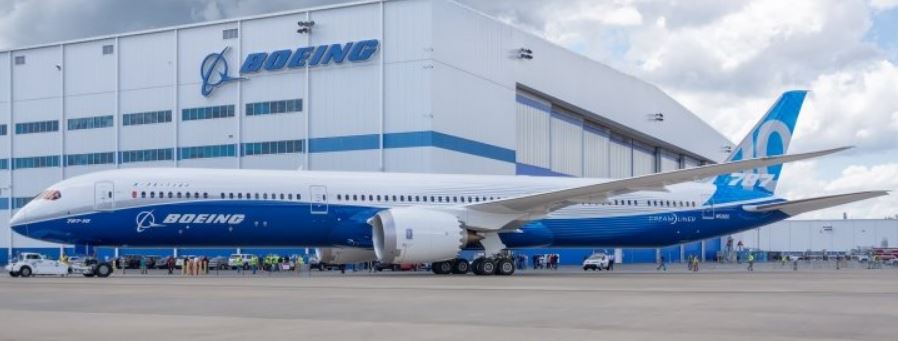
Light-weight carbon composite jet popular on Asian routes – 223 feet long, 6,400 mile range, 326 passengers
From Reuters
Boeing Co (BA) delivered its first 787-10 Dreamliner to Singapore Airlines (SIAL.SI) on Sunday, rounding out a family of lightweight jets on which the U.S. planemaker is betting its future.
The ceremonial key to the plane was handed to Singapore Airlines Chief Executive Goh Choon Phong on the tarmac at Boeing’s South Carolina plant, where the carbon composite jet is built, in front of more than a thousand Boeing workers and guests.
Goh called it a “beautiful aircraft” and an “unparalleled product for regional operations.”
Boeing Commercial Airplanes Chief Executive Kevin McAllister hailed the two airlines’ 45-year relationship.
Singapore Airlines was the first Southeast Asian carrier to buy Boeing’s 747 jumbo jet in 1972, Goh said, and the group is now the world’s first to operate all the 787 Dreamliner family of models.
The new Dreamliner was parked in front of a line of about 10 787 airplanes in various stages of completion.
Singapore Airlines, which expanded its order for 787-10s to 49 jets last year, plans to introduce the jet on services to Osaka, Japan, followed by Perth, Australia, starting in May.
The 787-10 is built exclusively at the North Charleston plant due to its large size, which prevents the transfer of sections to Boeing’s factory outside Seattle. Unlike the Washington state assembly lines, the plant, which has about 7,000 workers, is not unionized.
The aircraft, which sells for $326 million at list prices, completes a line-up of three models starting with the 787-8 which debuted in 2011. All boast carbon-composite fabrication materials, fuel efficiency and new state-of-the-air filtration systems with higher levels of humidity in the air for long-distance flight.
The 787-10’s range is 6,430 nautical miles (11,910 kilometers).
At 223 feet long (68 meters), the aircraft is 18 feet (5.5 meters) longer than the 787-9 and seats around 330 passengers, 40 more than the 787-9 and 88 more than the 787-8.
Europe’s Airbus (AIR.PA) competes against the 787-10 with its A330neo, an upgraded version of its most-sold wide-body aircraft with fuel-efficient engines and a new cabin.
Both jets are designed for shorter flights compared with other mid-size wide-body planes, tapping into the rapid growth of trade within Asia as well as across other regions.
But after brisk initial sales, orders for both models have slowed, with Airbus selling 214 of its A330neo.
The 787-10 has 171 orders, about 13 percent of the total of firm orders for the 787.
The mid-sized 787-9 is the most popular variant and competes mainly with Airbus’s new-generation carbon-composite A350.
The 787 and A330neo are locked in a fierce battle for sales and profits in the market for jets with around 300 seats.
Boeing looks poised to win a hotly contested order from American Airlines (AAL.O), beating competition from the A330neo, people familiar with the matter said on Friday.
From Modern Airliners
What makes the 787 fuel efficient?
As well as bringing large jet ranges to a medium sized jet, the Boeing 787 matches the speeds of larger jets with a cruise of Mach 0.85. This is delivered with an environmentally friendly fuel saving in the area of 20%.
Key to delivering this efficiency is a suite of new technologies.
Boeing 787 Composites
Weight is being reduced by the fact that up to 50% of the aircraft is built using composite materials, including the fuselage and wings. To put this in perspective, compare the Boeing 787 with Boeing’s current top selling Aircraft, the Boeing 777.
| BOEING 787 DREAMLINER | |
|---|---|
| Composite Materials | 50 Per Cent |
| Aluminium | 20 Per Cent |
| Other Materials | 30 Per Cent |
| BOEING 777 | |
| Composite Materials | 12 Per Cent |
| Aluminium | 50 Per Cent |
| Other Materials | 38 Per Cent |
The fuselage is constructed using single piece barrels joined end to end instead of multiple panels. This reduces the need for around 40,000—50,000 fasteners. Additionally it increased strength allowing for higher cabin pressures.
The Boeing 787 carries self monitoring systems that are able to report to ground based computer systems on the state of health of the aircraft and its systems. One third of the efficiencies come from the new technology engines. Boeing has chosen two engines to work with; the General Electric GEnx and Rolls-Royce Trent 1000. Both engines move from the old Bleed Air systems of powering aircraft systems such as; air conditioning and start-up, to electrical, thus moving to a more electrical aircraft. This is weight saving as well as less power drain on the engines.
Boeing 787 Dreamliner Materials Pictorial

A pictorial representation of the materials used to construct the Boeing 787 Dreamliner.