Perfect storm for Con Ed: New York’s frac ban, bogged-down pipeline approvals, skyrocketing customer demand for natural gas, customers transitioning away from heating oil leave New Yorkers without enough natural gas
All capacity for incoming gas pipes is already contracted – Con Ed
Thousands of Consolidated Edison’s (NYSE:ED) New York customers are transitioning to natural gas because community clean heat programs have required customers to switch from residual heating oil to cleaner heating fuels like natural gas. “The flexibility, environmental performance and high reliability of natural gas have also made the fuel attractive to many customers replacing existing heating systems or constructing new buildings,” Con Ed said in a press release.
“Growth in natural gas use has brought significant environmental and human health benefits to the region by reducing the use of more expensive and polluting fuels, especially residual oil,” the company said.
The company said that between 2011 and 2016, Con Edison converted 6,500 large buildings in New York City from oil to natural gas.
Con Ed said more efficiently managing natural gas usage in New York City and Westchester County is needed “because construction of new natural gas pipelines is not keeping pace with growing demand,” the utility said in a press release.
“We’re seeing strong growth in the need for natural gas in our service area, both from new building construction and the phase out of oil as a heating fuel,” said Marc Huestis, senior vice president of Gas Operations for Con Edison.
“While new gas transmission pipelines and other infrastructure may be needed in the next several years, we’ve submitted this proposal to advance more gas efficiency programs and partner with customers and other third-party businesses to achieve reductions in natural gas usage, especially on the coldest peak winter days.”
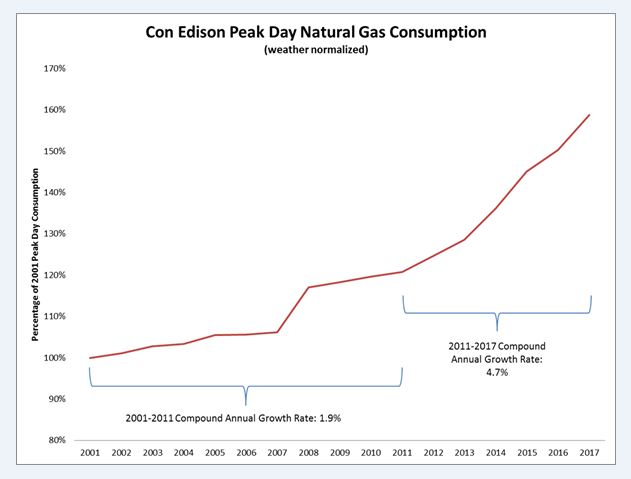
Since 2011, natural gas usage on the coldest winter days in Con Edison’s service territory has grown by more than 30 percent, and is expected to grow an additional 20 percent in the next 20 years. The company forecasts a shortfall in existing pipeline capacity by 2023, limiting the ability to meet the growing customer demand.
Con Ed’s filing recommended:
- Doubling from $14.5 million to $29 million per year the incentives available to customers for programs that conserve gas usage. This would double the annual savings and peak demand reduction target from 279,000 dekatherms/year and 6,000 dekatherms/day, respectively, to 560,000 dekatherms/year and 12,000 dekatherms/day.
- Creating new gas usage reduction programs that would be employed on the coldest winter days, a mirror to reducing electric demand during peak summer demand days.
- Developing renewable alternatives to natural gas heating, including efficient electric heating systems.
- Soliciting the energy marketplace for cost-effective alternatives to pipeline capacity to identify if customers’ heating needs can be met cost effectively with non-pipeline resources.
Con Ed’s said its customers’ conversions to natural gas have dramatically reduced emissions of sulfur dioxide, nitrogen dioxide, fine particulate matter, nickel, and greenhouse gases. Fine particulate matter emissions, for example, have been reduced by more than 500 tons on an annualized basis, equivalent to eliminating the particulate emissions from 1.6 million cars.
More pipeline capacity a dire need; all capacity for incoming gas pipes is already contracted
To maintain and extend these environmental gains, Con Edison will need additional pipeline capacity or an alternative means to balance supply and customer demand on its system. All pipeline capacity coming into the company’s service territory is contracted, and there are no projects underway that would provide additional capacity to serve the company’s customers.
The company has considered multiple proposals to increase the pipeline capacity for its customers, and continues to do so. Recently proposed pipeline projects, however, have stalled due to a failure to secure permits needed prior to construction. As a result the company is taking steps to explore all options to meets its customers’ needs.
The steps include early activities to bring more pipeline capacity to the area and, through greater conservation, reducing the size of the pipeline that is needed. If conservation efforts and innovative alternatives for heating are successful and cost-effective, the company could avoid the pipeline project, but because of the large shortfall in capacity, it will be difficult to meet growing customer needs solely through conservation.
Today’s proposal would help the company continue to reliably meet the heating needs of its customers. The programs Con Edison proposes are intended to help the company avoid having to institute moratoriums on the interconnection of new customers to its natural gas system. Moratoriums would increase consumer costs and forego opportunities to achieve near-term environmental benefits by moving customers to cleaner heating fuels.
Consolidated Edison, Inc. has $12 billion in annual revenues and $49 billion in assets. The company has two regulated utility subsidiaries, Consolidated Edison Company of New York, Inc., and Orange and Rockland Utilities, Inc., and two unregulated subsidiaries, Con Edison Clean Energy Businesses, Inc. and Con Edison Transmission, Inc.