Revenue up 93% YOY; first Delaware XRL producing 2,000 BOEPD for 100 days; PDC spuds 44 Wattenberg wells in Q2
PDC Energy (ticker: PDCE) announced second quarter results today, showing net income of $41.2 million, or $0.62 per share. This considerably exceeds the $95.5 million loss the company took in Q2 2016, and is almost equal to the $46.1 million PDC earned in Q1 2017.
PDC reports that its revenue from oil and gas operations increased 93% year-over-year, from $110.8 million in Q2 2016 to $213.6 million in Q2 2017. Total production was just over 8 MMBOE this quarter, up 54.2% from Q2 2016, while weighted average sales prices increased by 25% year-over-year.
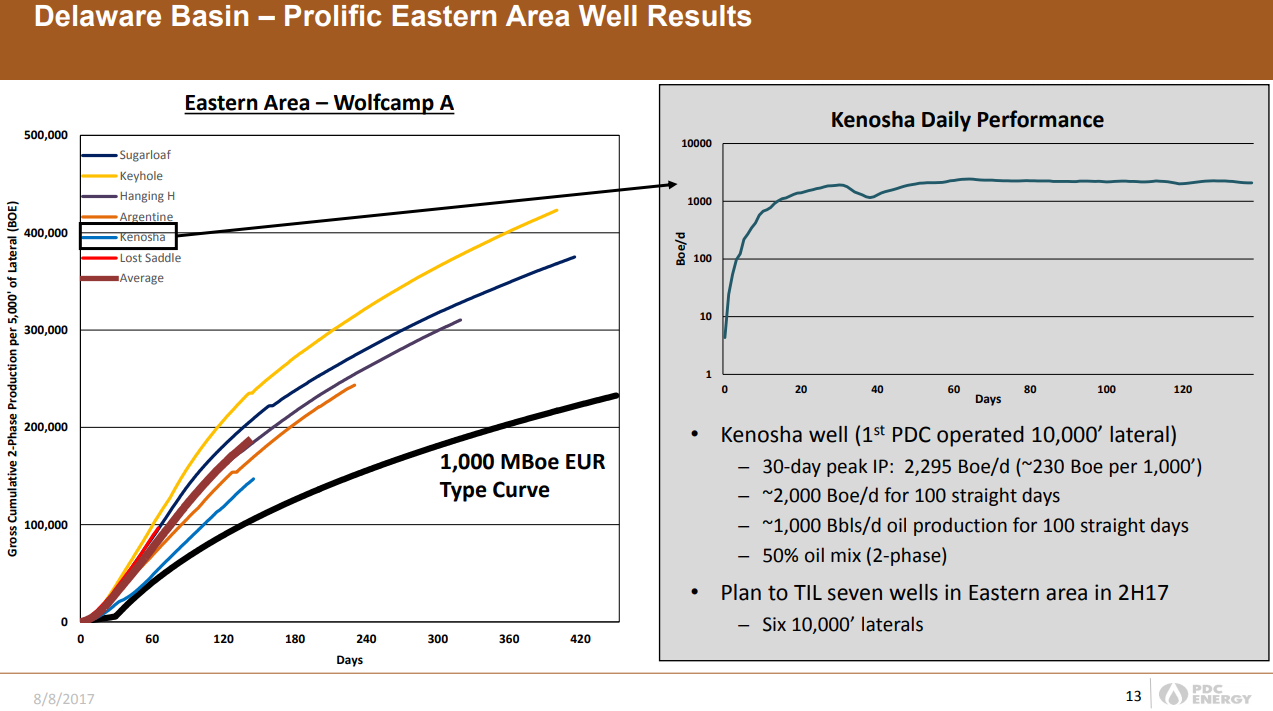
First Delaware XRL producing over 2,000 BOEPD for last 100 days
PDC brought six wells to production in the Delaware, and had average production of 10,047 BOEPD, up 49% from Q1 2017. The company’s first extended reach lateral well in the basin has had strong results so far, with production over 2,000 BOEPD for the past 100 days. PDC plans to operate three drilling rigs for the rest of the year, focusing on more extended reach lateral wells in the eastern portion of the company’s acreage.
PDC spud 44 Wattenberg wells in Q2, and brought 32 new wells to production. Daily production from the basin was 75,621 BOEPD. PDC reports it has realized increased drilling efficiencies in 2017, allowing the company to drill wells in even shorter times. These improvements mean PDC can achieve its production goals with fewer rigs, and the company has therefore reduced its operated rig count in the Wattenberg to three for Q4 2017. Despite this reduction in rigs, PDC expects to spud more wells in the basin than previous estimates.
PDC President and CEO Bart Brookman commented on this quarter’s results, saying “Our quarterly production results demonstrate improved capital efficiencies and completion enhancements in the Wattenberg, as well as the momentum we are building in the Delaware Basin. In Wattenberg, we further reduced drilling times, which will allow us to drop our rig count to three this October and maintain a similar pace of development. We have great operational flexibility in both basins to increase or decrease our rig counts depending on market conditions. Lastly, we are excited by the work of our operating teams in not only delivering strong recent well results in the Delaware Basin, but improving our operating cost structure in the quarter.”
PDC Energy is a presenting company at EnerCom’s The Oil & Gas Conference® next week, which runs Aug. 13-17, 2017, at the Denver Downtown Westin Hotel. To register for the EnerCom conference, please visit the conference website.
Q&A from PDCE Q2 conference call
Q: You talked about inflation in Delaware, basically everywhere. Can you just talk about what is the primary thing that’s driving that outside? I know it’s a very active basin, but is it on the completion side, the sand side or – and on top of that, what is the current well cost for a 2-mile lateral?
PDCE: When we look at this overall we’re looking at about a 15% increase, maybe a little over that from the last numbers we published. And so, that will give you a good idea of where we’re at in terms of costs. When you talk about where that’s coming from, it’s coming from really across-the-board costs. It’s a drilling completion.
Everything we do is just a little bit more money out there right now.
And so, that’s what we’re seeing happen. And I think it’s pretty much a part of the Delaware process right now for all of the companies. We don’t see any particular area where you’d go that’s the biggest movement in the capital cost, if you want to look at it that way as well.
Q: I wanted to switch gears a bit and go to slide 13 where you gave that Kenosha well performance, not very typical, this flat decline that you’ve seen. Is that because the well was put on ESP or is there something else happening and is that a production trajectory that you’ve seen from other wells in that area?
PDCE: It’s an interesting well and it’s a 2-mile lateral, and we don’t have it on artificial lift. It’s a flowing well. It’s a very strong well. The pressures mirror up to the type of production profile you see. We’ve seen very strong pressure response to the completion. And I think we’re looking at a well here that’s got a lot of horsepower behind that well into the future.
And when you combine that with the idea that we’re still cleaning it up, if you want to call it that, and that we’re still producing a substantial amount of water associated with the original completion, that well, it just looks like it’s going to be a phenomenal well to us. And it’s got the right combination of I guess bringing it online and not getting too excited about over producing it early and a really good combination of that, coupled with good completion and the right idea about how to produce it into the future.
Q: So, is it fair to say this is a managed flow back?
PDCE: It is a managed flow back, that’s correct. And we do that across our wells in the Wattenberg, and we’re watching very carefully to make sure we don’t overproduce some early. And if over time, and I’m saying over a long period of time, not over the next couple of wells, but there – we could probably get more aggressive with these wells, if we see that there – it’s not affecting them.
Q: I think you all said earlier, you need about two rigs to manage your leasehold HBP obligations [in the Delaware]. Can you just talk about how you think laying out the development plan through 2018 to not only manage HBP but also to test spacing intervals and also to test even spacing vertically in your acreage?
PDCE: So, at the three rig program that we currently have, we believe not only will we HBP the positions that we have, but we’ll also be able to test the down spacing as well. We brought in the fourth rig earlier this year in the Delaware so that we can kind of get out ahead of some of the HBP work that we had to do. And the benefit of that is that that means that for HBP in the 2018, we’re estimating sort of the two to maybe three rig program to HBP.
And then the – that extra time for that third rig will be spent working on the down-spacings that we have in the Eastern area, as well as drilling additional wells in eastern and wells also in the central area. So, there’s a lot of work that’s going into this, a lot of the teams has done a great job, putting forward their drilling schedules and plans. But we think it’s going to be a very solid program for the company in 2018 that tests all of those types of things for the company.
Couple other comments, just on where we’re at now in a little bit shorter-term look. We are converting over as time passes from individual wells to multi-well pads. And I – we have – the three rigs, we have running right now, we’re on two – one is on the two-well pad and the other two are on three-well pads. So, we are getting some of the benefit and some of the efficiencies.
And then, later in the year, we have a larger well pad, so something on the order of — I think it’s going to be about nine wells. We’re still working on that final plan, but about nine wells that we’ll be drilling in the Eastern acreage, and we’ll be testing very soon. So, you’re down, the spacing in between wells and the other factors that we’re taking into consideration, so starting to get some benefits of some time to actually move away from just single-well pads.