
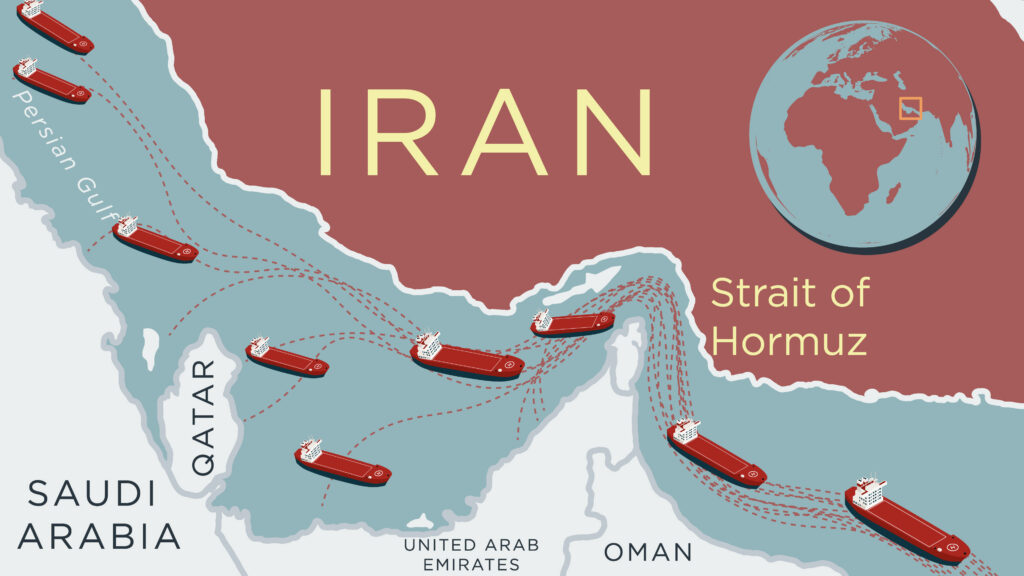
(Investing) – DUBAI/RIYADH – A proposed deal between Iran and Oman to help end five months of war between Iran and the United States would give Tehran control over ships entering the Gulf through the Strait of Hormuz, a senior Iranian source and two regional officials told Reuters on Wednesday, one of the biggest concessions yet to Iran.
There was no immediate U.S. comment on the proposal, and while President Donald Trump has said a deal reopening the strait is imminent, U.S. officials have repeatedly insisted they would never agree to Iran controlling access to the world’s most important trade route for energy supplies.
An agreement that gives Iran any control over access to the strait would mean the war launched by the United States and Israel in February had resulted in a major shift in the balance of regional power in Tehran’s favour. Before the war, the strait was freely open to all ships with no fees.Iran reported “significant progress” in the talks with Oman and said both inward and outward journeys would pass through Iranian waters.
UNRESOLVED ISSUES
However, the regional and Iranian sources who spoke to Reuters cautioned that significant issues remained unresolved and also pushed back against suggestions from Trump that a deal reopening the strait was imminent.
“The concession has already been made regarding some form of control over Hormuz,” one of the regional sources told Reuters.
The other regional source said there were still details to be determined about how “control” would be defined, with Gulf negotiators insisting regional countries supervise inspections of ships, and that any payment of fees be voluntary.
The senior Iranian source said the text of an agreement already on the table envisioned Iran having control of ships heading into the Gulf through the strait, and one of the main sticking points was what role Iran would also have over ships heading in the opposite direction.
In comments to Iran’s official IRNA news agency, Iranian Deputy Foreign Minister Kazem Gharibabadi said the arrangement was “designed in such a way that commercial ships will pass through Iranian territorial waters, both on the inbound and outbound legs of their journey.”
He said the talks with Oman had “reached fundamental understandings” and added: “This progress is on the verge of being finalised.”
Gharibabadi also said Iran had received messages from the United States indicating that it was “fully prepared to return to its commitments” under a mid-June memorandum of understanding with Iran that provided for immediate cessation of military operations.
He said this was a condition for reopening of the strait, but not enough in itself, while adding that no talks with the United States had been held in recent days.
TRUMP FACES VOTER PRESSURE
Trump, who at the start of the war said it would end in Iran’s “unconditional surrender” and with him approving the choice of its leader, has been under pressure to find a way out of a conflict U.S. voters oppose by two-to-one ahead of crucial midterm elections in November.
Months of U.S. military efforts, including a two-week campaign of strikes in July, have not broken Iran’s grip on the strait. U.S. commanders advised Trump in July that they were running low on supplies of some munitions. Reuters reported on Tuesday that the U.S. Army had used up nearly all of its long-range precision missiles.
Crude prices have plunged over the past two days after Trump called off fresh attacks on Iran citing talks he said could end the conflict.
Prices edged lower on Wednesday, although losses were capped by a maritime embargo declared by Yemen’s Iran-aligned Houthis on Saudi ports and vessels, heightening risks to Red Sea shipping.
The Houthis said on Wednesday they had launched a missile attack on a Saudi oil tanker off the coast of the Red Sea port city of Yanbu and another missile attack on a Saudi oil tanker in the Gulf of Aden. There was no Saudi confirmation on either incident.
Trump told Fox News’ “@ Night with Trace Gallagher” programme on Tuesday that talks were “moving along nicely” and “an all-day negotiation” had taken place that day.
He said the strait “is going to be open very soon”.
Over the weekend, Trump cited the negotiations as the reason for a decision to call off plans for “massive attacks” on Iran, a pattern he has repeated numerous times throughout the war.
An Iranian source said: “The devil is in the details. A single tweet from Trump could cause the whole thing to collapse.”
At a regular briefing in New York, deputy U.N. spokesperson Farhan Haq said the United Nations had received no first-hand information about a possible reopening of the Strait of Hormuz, but added: “We certainly encourage the parties to move forward with any effort to have a negotiated solution to the issue.”
According to the senior Iranian official, Iran is seeking fees of between 5% and 7% of the price of cargoes from ships using the strait. Oman is discussing smaller fees of around 3%, while Washington wants no fees at all.
Making any fees voluntary, at least nominally, could be a way out of the impasse, although an implied threat of Iranian attacks could mean shippers would be unlikely to risk transit without paying.
(Reporting Menna Ala El Din, Elwely Elwelly and by Reuters bureaux; Writing by Peter Graff, Alison Williams and David Brunnstrom; Editing by Hugh Lawson, Alison Williams and Sanjeev Miglani)