(Oil and Gas 360) – Energy Advisors examines the strategic implications of Transocean’s $5.8 Bn all-stock acquisition of Valaris. Click here to download the report.
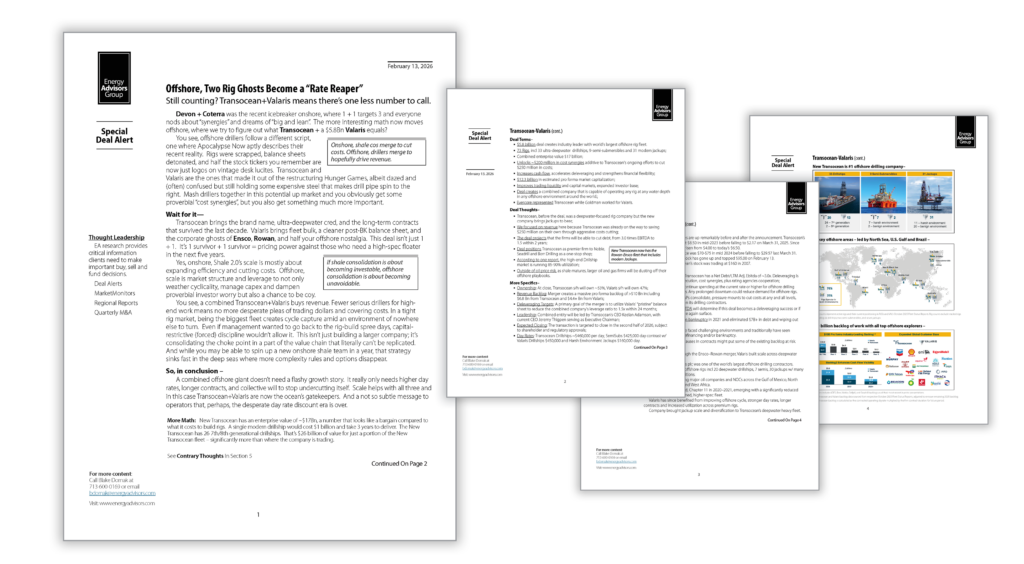 Still counting? Transocean + Valaris means there’s one less number to call.
Devon + Coterra was the recent icebreaker onshore, where 1 + 1 targets 3, and everyone nods about “synergies” and dreams of “big and lean.” The more interesting math now moves offshore, where we try to figure out what Transocean + a $5.8 Bn Valaris equals.
You see, offshore drillers follow a different script, one where Apocalypse Now aptly describes their recent reality. Rigs were scrapped, balance sheets detonated, and half the stock tickers you remember are now just logos on vintage desk lucites. Transocean and Valaris are the ones that made it out of the restructuring Hunger Games, albeit dazed and (often) confused but still holding some expensive steel that makes drill pipe spin to the right. Mash drillers together in this potential up market, and you obviously get some proverbial “cost synergies,” but you also get something much more important.
Wait for it.
Transocean brings the brand name, ultra-deepwater credibility, and the long-term contracts that survived the last decade. Valaris brings fleet bulk, a cleaner post-bankruptcy balance sheet, and the corporate ghosts of Ensco, Rowan, and half your offshore nostalgia. This deal isn’t just 1 + 1. It’s 1 survivor + 1 survivor = pricing power against those who need a high-spec floater in the next five years.
Yes, onshore, Shale 2.0’s scale is mostly about expanding efficiency and cutting costs. Offshore, scale is market structure and leverage to not only weather cyclicality, manage capex, and dampen proverbial investor worry, but also a chance to be coy.
You see, a combined Transocean + Valaris buys revenue. Fewer serious drillers for high-end work means no more desperate pleas of trading dollars and covering costs. In a tight rig market, being the biggest fleet creates cycle capture amid an environment of nowhere else to turn. Even if management wanted to go back to the rig-build spree days, capital-restrictive (forced) discipline wouldn’t allow it. This isn’t just building a larger company; it’s consolidating the choke point in a part of the value chain that literally can’t be replicated. And while you may be able to spin up a new onshore shale team in a year, that strategy sinks fast in the deep seas where complexity rules and options disappear.
So, in conclusion.
A combined offshore giant doesn’t need a flashy growth story. It really only needs higher day rates, longer contracts, and the collective will to stop undercutting itself. Scale helps with all three, and in this case, Transocean + Valaris are now the ocean’s gatekeepers. And a not-so-subtle message to operators that, perhaps, the desperate day-rate discount era is over.
Market Thoughts–
Both firms’ stock prices are up remarkably before and after the announcement. Transocean’s stock (RIG) traded at $8.50 in mid-2023, then fell to $2.17 on March 31, 2025. Since January 1, the stock has risen from $4.00 to today’s $6.50. Valaris (VAL) stock price was $70–$75 in mid-2024 before falling to $29.57 last March 31. Since Spring 2025, the stock has gone up and topped $95.00 on February 13. Before shale, Transocean’s stock was trading at $160 in 2007.
Who is/was Valaris?
- Formed in 2019 through the Ensco–Rowan merger, Valaris built scale across deepwater and shallow-water.
- Houston-based Valaris plc was one of the world’s largest offshore drilling contractors.
- Owned a global fleet of offshore rigs incl 20 deepwater drillships, 7 semis, 30 jackups, w/ many designed for harsh conditions.
- Diversified fleet serving major oil companies and NOCs across the Gulf of Mexico, North Sea, Middle East, Brazil, and West Africa.
- Company restructured, Chapter 11 in 2020–2021, emerging with a significantly reduced debt load and a streamlined, higher-spec fleet.
- Valaris has since benefited from improving offshore cycle, stronger day rates, longer contracts, and increased utilization across premium rigs.
- The company brought jackup scale and diversification to Transocean’s deepwater heavy fleet.
More Math.
New Transocean has an enterprise value of ~$17Bn, a number that looks like a bargain compared to what it costs to build rigs. A single modern drillship would cost $1 Bn and take 3 years to deliver. The New Transocean has 26 7th/8th generational drillships. That’s $26 Bn of value for just a portion of the New Transocean fleet – significantly more than where the company is trading.
Deal Terms–
- $5.8 Bn deal creates industry leader with world’s largest offshore rig fleet;
- 73 Rigs, incl 33 ultra-deepwater drillships, 9 semis and 31 modern jackups;
- Combined enterprise value $17 Bn;
- Unlocks ~$200 million in cost synergies additive to Transocean’s ongoing efforts to cut $250 million in costs;
- Increases cash flow, accelerates deleveraging, and strengthens financial flexibility;
- $12.3 Bn in estimated pro forma market capitalization;
- Improves trading liquidity and capital markets, expanded investor base;
- Deal creates a combined company that is capable of operating any rig at any water depth in any offshore environment around the world.;
- Evercore represented Transocean while Goldman worked for Valaris.
Deal Thoughts–
- Transocean, before the deal, was a deepwater-focused rig company, but the new company brings jackups to bear;
- We focused on revenue here because Transocean was already on the way to saving $250 million on its own through aggressive cost-cutting;
- The deal projects that the firms will be able to cut debt from 3.0 times EBITDA to 1.5 times within 2 years;
- Deal positions Transocean as a premier firm to Noble, Seadrill, and Borr Drilling as a one-stop shop;
- According to one report, the high-end drillship market is running 85-90% utilization;
- Outside of oil price risk, as shale matures, larger oil and gas firms will be dusting off their offshore playbooks.
More Specifics–
- Ownership: At close, Transocean s/h will own ~53%, Valaris s/h will own 47%;
- Revenue Backlog: Merger creates a massive pro forma backlog of >$10 Bn, including $6.8 Bn from Transocean and $4.4+ Bn from Valaris;
- Deleveraging Targets: A primary goal of the merger is to utilize Valaris’ “pristine” balance sheet to reduce the combined company’s leverage ratio to 1.5x within 24 months;
- Leadership: Combined entity will be led by Transocean’s CEO Keelan Adamson, with current CEO Jeremy Thigpen serving as Executive Chairman;
- Expected Closing: The transaction is targeted to close in the second half of 2026, subject to shareholder and regulatory approvals;
- Day Rates: Transocean drillships ~$460,000/day, semis $425,000/day, contrast w/Valaris drillships $450,000/day and harsh environment jackups $160,000/day.
Deal Risks.
- At close, New Transocean has a Net Debt/LTM Adj. Ebitda of ~3.0x. Deleveraging is dependent upon execution, cost synergies, plus rating agencies’ cooperation;
- For E&Ps to continue spending at the current rate or higher for offshore drilling depends on oil prices. Any prolonged downturn could reduce demand for offshore rigs;
- As E&Ps consolidate, pressure mounts to cut costs at any and all levels, including pressure on its drilling contractors;
- The trajectory of EBITDA will determine if this deal becomes a deleveraging success or if refinancing risks once again surface;
- Valaris emerged from bankruptcy in 2021 and eliminated $7B+ in debt and wiping out equity holders;
- Offshore drillers have faced challenging environments and traditionally have seen multiple phases of refinancing and/or bankruptcy;
- Change of control clauses in contracts might put some of the existing backlog at risk.
About Energy Advisors oilandgas360.com contributor
Energy Advisors is a leading firm in oil and gas transaction advisory services and thought leadership, having served the industry for over 35 years. We trace our roots back to PLS Inc which sold its listing service, research, and databases to DrillingInfo in 2018 and rebranded its advisory and marketing arm as Energy Advisors in 2019.
Contacts:
Brian Lidsky
Director of Research
713-600-0138
Blake Dornak
VP, Marketing
713-600-0123
bdornak@energyadvisors.com
The views expressed in this article are solely those of the author and do not necessarily reflect the opinions of Oil & Gas 360. Please consult with a professional before making any decisions based on the information provided here. The information presented in this article is not intended as financial advice. Contact Energy Advisors for the full report. Please conduct your own research before making any investment decisions.