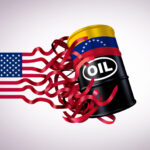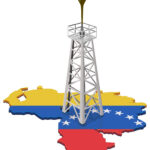
(Oil & Gas 360) by Greg Barnett, MBA – Inside America’s 65-Billion-Barrel Venezuela Transaction: President Donald Trump calls it “The Biggest Oil Deal in World History.” Venezuela says the agreement covers 17 strategic oil fields containing approximately 65 billion barrels of recoverable oil, could attract more than $100 billion of private investment and could generate more than $209 billion of taxes and royalties for Venezuela.

Those are extraordinary numbers. The transaction behind them may be more unusual.
Public descriptions indicate that Washington would obtain a large economic interest tied to the fields plus preferential rights to purchase production at cost. Some barrels could go to the Strategic Petroleum Reserve or U.S. military requirements. North American Blue Energy Partners (NABEP), a Barbados-based private producer, has emerged near the center of the structure.
But as of August 31, the contracts have not been released. Washington and Caracas describe important provisions differently. The ultimate U.S. equity holder is unclear. So is the source of the enormous development capital required. Before considering what 65 billion barrels might eventually do to world oil markets, the first job is to understand the transaction.
What America Says It Secured
According to U.S. descriptions reported by the Associated Press, Washington and a private Venezuelan operator would create a new private company holding rights to the 17 fields. U.S. officials describe America receiving 55% of the venture’s “effective output,” combining an economic ownership interest with preferential rights to purchase crude at cost.
Reuters reports approximately 63.7 billion barrels of recoverable oil, rounded publicly to 65 billion, mostly associated with eight large Orinoco Belt blocks, with additional fields around Lake Maracaibo. The calculation reportedly assumes a technically feasible recovery factor of about 20%. Some acreage is greenfield; other fields have infrastructure requiring substantial rehabilitation.
A critical distinction remains unresolved. Public reporting alternately describes the 65 billion barrels as recoverable resources, recoverable reserves and proven reserves. Until reserve reports and engineering studies are released, investors should be careful not to treat those terms as interchangeable. That matters. Sixty-five billion barrels of reserves are not 65 billion immediately marketable barrels. Wells, gathering systems, pipelines, storage, power, treatment, diluent, terminals and security all require capital. That is the physical backdrop to the $100 billion investment figure surrounding the agreement.
Rodríguez: Venezuela Keeps the Resource
Interim president Delcy Rodríguez describes the bargain differently from the language of U.S. “control.” Her case is that Venezuela retains ownership of its hydrocarbons while American capital and technology help convert reserves into production. “Venezuela contributes oil, its industry and the experience of its workers over more than 100 years; the United States offers the capital and technology necessary to recover and develop those assets,” said Rodríguez, translated from Spanish-language remarks on August 29, 2026.
Rodríguez says the agreement has a 25-year term, covers 17 fields including eight greenfield Orinoco blocks, targets production above 1.5 million barrels per day, provides minimum royalties of 16% and maintains a 34% income-tax rate. Using $65 oil, she calculates approximately $209.335 billion for Venezuela. Rodriguez said: “In concrete terms, this means that, for every barrel produced and sold, close to 19 dollars enter our country directly.”
Her argument is unapologetically commercial: reserves underground do not create national wealth until someone develops them. Yet her 25-year description conflicts with U.S. accounts that initially referred to rights extending as long as 100 years. Until the contracts are public, those are competing descriptions, not interchangeable facts.
NABEP, Betancourt and Bluwaves
The private company attracting the most scrutiny is NABEP. Its website identifies headquarters in Bridgetown, Barbados, and offices in Caracas, Maracaibo and Lechería, but provides little public financial detail: no financial statements, capitalization table or conventional management and board disclosure. NABEP is nevertheless a significant Venezuelan producer. Recent reporting puts production around 200,000 barrels per day and says the company is considering as much as $5 billion of debt while pursuing output of one million barrels per day within five years.
NABEP is controlled by Venezuelan businessman Alejandro Betancourt López (Betancourt). Betancourt became prominent through Venezuelan power-sector contracts and later expanded into petroleum. He has faced investigations and allegations involving corruption and money laundering in several jurisdictions; reporting notes that he has not been criminally charged in those matters.
The ownership trail became more interesting in August. Florida energy businessman Harry Sargeant III held a minority NABEP interest through Bluwaves Properties Limited, a British Virgin Islands company. Bloomberg reported that Sargeant agreed in early August to sell the offshore vehicle — and therefore his NABEP interest — for $300 million to a party close to Betancourt.
On August 18, Treasury’s Office of Foreign Assets Control added BLUWAVES PROPERTIES LIMITED to the Specially Designated Nationals list under Venezuela sanctions authority. Reuters subsequently reported that Bluwaves had formerly been owned by Sargeant and had been sold for $300 million earlier in August.
The timing merits reporting, not speculation. The available evidence indicates a secondary sale of the holding company through which Sargeant owned his interest, not a $300 million primary capital contribution to NABEP. Oil & Gas 360 also has not identified a Form D filing for a NABEP U.S. private securities offering. That does not prove NABEP has received U.S. capital; financing could be offshore, debt, affiliate-level or otherwise outside a Form D filing requirement. It does mean NABEP’s capitalization remains unusually opaque for a company potentially central to a transaction of this scale.
Who Owns the U.S. Interest?
Weekend reporting added another unresolved issue. The Wall Street Journal reported that the U.S. government plans to obtain a 35% passive stake in NABEP plus preferential rights to purchase 20% of production at cost. It reported that the Pentagon’s Office of Strategic Capital (OSC) would structure the equity component using penny warrants.
The Pentagon then complicated that description. Chief spokesman Sean Parnell told Reuters that OSC does not take equity stakes in private companies; its statutory role is limited to loans, loan guarantees and technical assistance, including transaction structuring. If OSC lacks statutory authority to hold equity, then either the reporting regarding the warrant structure is incorrect, another federal entity would be the beneficial holder, or the administration intends to utilize a legal structure not yet publicly disclosed.
If both reports are substantially correct, an important piece is missing: which U.S. government entity would actually hold the warrants or shares? The reported 35% passive interest plus 20% at-cost purchase right provides an apparent arithmetic path to the administration’s 55% “effective output,” but the structure remains reported rather than documented.
Even if financing emerges and development proceeds, political durability remains a major risk. Oil projects spanning decades depend upon stable legal regimes. Any future Venezuelan administration could seek to revisit, renegotiate or challenge agreements negotiated during the current transitional period, particularly if the fields become materially more valuable over time.
Wright: Capital, Licenses and Production
The transaction did not appear from nowhere. In January, the Department of Energy said the administration had begun marketing Venezuelan crude globally, with proceeds initially settling in U.S.-controlled accounts. Secretary Chris Wright traveled to Caracas in February and described an explicit effort to reopen Venezuela to capital and operating companies. Said Wright back in February 2026: “Our government in Washington, DC, has been working seven days a week to issue licenses, so existing businesses in Venezuela, new businesses that want to enter Venezuela, Venezuelan national companies can buy products, invest money, raise oil production, create new jobs, grow export revenue.”
By late August, that policy had moved from licenses and crude marketing toward field-level investment. Chevron and other international companies are separately negotiating or expanding Venezuelan operations, but those company-level agreements should not automatically be conflated with the 17-field structure.
The $100 Billion Question
Venezuela says the project could attract more than $100 billion. U.S. officials have promoted a similar private-investment figure. Yet the contracts identifying investors, commitments and funding schedules remain unavailable.
NABEP’s reported $5 billion debt ambition is meaningful, but it is only a fraction of $100 billion. Major operators, banks, infrastructure funds, commodity traders, private equity or government-supported credit could provide other pieces. If OSC supplies loans or guarantees, that could materially change both the cost of capital and the allocation of risk.
For now, $100 billion is a stated investment objective, not a publicly documented financing package. Comparable megaprojects are typically supported by identifiable sponsors, lending syndicates, export-credit agencies, infrastructure funds or strategic partners. As of August 31, none have been publicly identified for the Venezuela transaction.
The Documents Are Now the Story
The broad outline is visible. Both governments acknowledge 17 fields and roughly 65 billion barrels. Rodríguez says the term is 25 years, production could exceed 1.5 million barrels per day and Venezuela retains ownership of the petroleum. U.S. officials describe 55% effective output and at-cost crude rights that could serve strategic and military requirements.
We also know NABEP and Betancourt are important to the developing structure; Bluwaves held Sargeant’s minority NABEP interest; that vehicle was reportedly sold for $300 million shortly before the announcement; and Treasury subsequently sanctioned Bluwaves. Treasury’s public designation identifies Bluwaves as operating in Venezuela’s oil sector, but the designation itself does not allege that the reported sale was improper.
What remains missing is consequential: signed contracts; the definitive field list and reserve reports; NABEP’s complete capitalization; the U.S. equity holder; warrant documents; the definition of “at cost”; detailed cost-recovery and fiscal mechanics; committed sources for the $100 billion; field operators; and any disclosed signing bonus or other upfront consideration. No public explanation has yet been provided regarding dispute resolution, governing law, arbitration venue or sovereign-immunity considerations should a future disagreement arise between the parties.
Trump may ultimately be right that this is the biggest oil deal in world history. But oil transactions are judged by contracts, capital and production. Perhaps the most telling reaction has come from lawyers and energy analysts who are not debating the economics yet. They are asking to see the contracts. Until those documents become public, fundamental questions regarding legality, ownership, governance, financing and enforceability cannot be independently verified.
If federal loans, guarantees or taxpayer-backed financial support ultimately become part of the structure, public scrutiny will intensify substantially should the project underperform expectations. Today, there is far too little public information to answer it. But if the deal falters—particularly if U.S. government loans, guarantees or other financial support are at risk—the world will demand answers. For now, 65 billion barrels are the headline. The deal structure is the story.
By oilandgas360.com contributor Greg Barnett, MBA.
The views expressed in this article are solely those of the author and do not necessarily reflect the opinions of Oil & Gas 360. Please consult with a professional before making any decisions based on the information provided here. Please conduct your own research before making any investment decisions.