(Oil & Gas 360) By Greg Barnett
Few geographic features exert as much influence over the modern global economy as the Strait of Hormuz. At its narrowest point, barely twenty-one miles wide, the Strait serves as the sole maritime gateway from the Persian Gulf to global markets.

Its importance did not emerge overnight; rather, it evolved alongside the globalization of oil trade, tanker technology, and geopolitical rivalry. This article traces the evolution from the emergence of very large crude carriers (VLCCs) through major historical shocks and present day, with a focus on why Hormuz remains central to oil market risk assessment for industry professionals and investors.
The VLCC Era and the Scaling of Risk (1960s)
The strategic importance of the Strait of Hormuz expanded dramatically with the rise of (VLCCs) in the mid-1960s. As tanker size increased, Middle Eastern producers gained the ability to move vast volumes of crude efficiently to distant markets. This transformation coincided with the closure of the Suez Canal in 1967, reinforcing the logic of long-haul crude movements and concentrating flows through Hormuz. From this point forward, disruption at the Strait no longer threatened marginal barrels, it threatened system-scale supply.
World War II and the Foundations of Energy Security
Although global oil markets were not yet fully integrated during World War II, the conflict established enduring principles of energy security. Control of supply routes, refinery infrastructure, and maritime corridors proved decisive to industrial warfare. The Persian Gulf emerged as a strategic rear area whose stability mattered far beyond the region itself, setting a precedent that would later apply directly to Hormuz.
The 1970s Oil Shocks: Hormuz Enters the Macro Consciousness
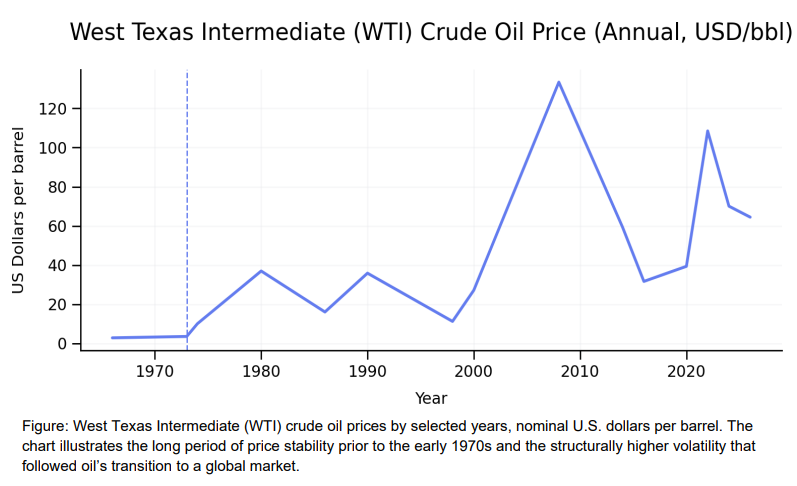
The first oil shock of 1973–74 marked the moment when oil became a macroeconomic variable. While the Strait of Hormuz was not physically closed, the crisis revealed how dependent consuming nations had become on Gulf exports. Price movements accelerated sharply, reflecting not only lost barrels but also fear of prolonged disruption.
The Iranian Revolution and Hostage Crisis
The Iranian Revolution of 1979 and the subsequent hostage crisis fundamentally altered Gulf geopolitics. They hardened U.S.–Iran relations and embedded the Strait of Hormuz within a broader framework of strategic rivalry. From this point onward, Hormuz risk included not only state conflict but also ideology, sanctions, and asymmetric pressure.
The Tanker War and the Militarization of Shipping (1980s)
During the Iran–Iraq War, attacks on commercial shipping transformed theoretical risk into operational reality. The mining of Gulf waters and attacks on tankers forced the United States and its allies to escort vessels and actively secure shipping lanes. This period demonstrated that Hormuz could be functionally closed through risk and insurance dynamics even without a formal blockade.
The 1986 Oil Price Collapse
The mid-1980s oil price collapse highlighted the interaction between geopolitics and market structure. As prices fell, fiscal pressure on exporting states increased, raising the strategic value of uninterrupted export routes. Even in an era of apparent abundance, the Strait of Hormuz remained a critical vulnerability.
From the 1990s to Today: Persistent Chokepoint Risk
From the Gulf War through the post-2000 era of sanctions, tanker seizures, and regional conflict, Hormuz has remained central to oil market risk. Roughly one-fifth of globally traded petroleum continues to transit the Strait, with limited viable alternatives. In recent years, the dominant risk mechanism has been commercial rather than military: insurers, shipowners, and charterers responding to perceived danger by halting transit.
Conclusion
The history of the Strait of Hormuz mirrors the history of oil itself, from local commodity to global strategic asset. For industry professionals and investors, Hormuz is not merely a geographic constraint, but a recurring source of volatility embedded in prices, freight, and policy responses. Understanding its history is essential to understanding the modern energy system.
By oilandgas360.com contributor Greg Barnett, MBA.
“The views expressed in this article are solely those of the author and do not necessarily reflect the opinions of Oil & Gas 360.