Focused on completions: 233 wells will be completed in 2017
Whiting Petroleum (ticker: WLL) announced first quarter results yesterday, showing a net loss of $87 million, or ($0.24) per share. After adjusting for impairments, derivative losses and other special charges, Whiting reported an adjusted loss of $54.2 million for the quarter.
Overall, Whiting had a successful three months:
- Average production in Q1 was 117,360 BOEPD, which is at the high end of previous guidance.
- LOE, G&A and interest expenses were at the low end of guidance.
- DD&A per BOE and oil price differentials were actually below the low end of guidance, primarily due to additional infrastructure in the Williston basin driving down transport differentials.
Williston basin enhanced completions find success
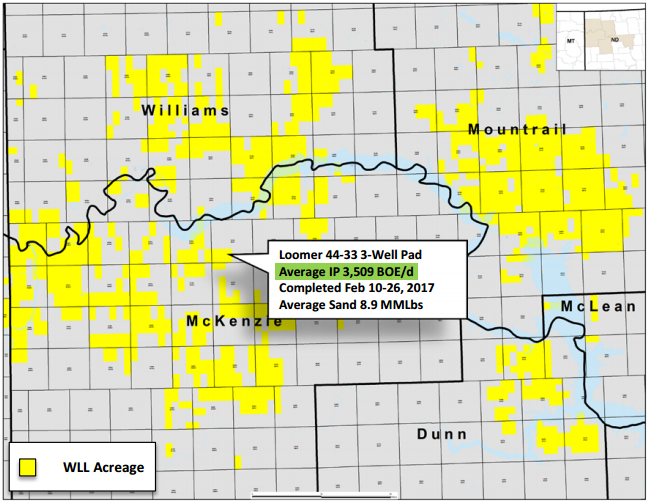
Whiting is primarily focused on activities in the Williston Basin, where the company owns more than 443,000 net acres. Whiting’s Williston production averaged 109,125 BOEPD this quarter, 93% of total production.
The company recently completed three wells at the Loomer pad, a location significantly west of previously reported enhanced completions in McKenzie County. These wells used more frac stages, diverter agents, and additional sand. Whiting reports that on average the three wells are tracking a 1.5 MMBOE type curve.
This success suggests that the enhanced completion design can be implemented across the majority of the company’s Williston basin acreage. Current plans are to use this design on wells going forward, and test still higher sand volumes.
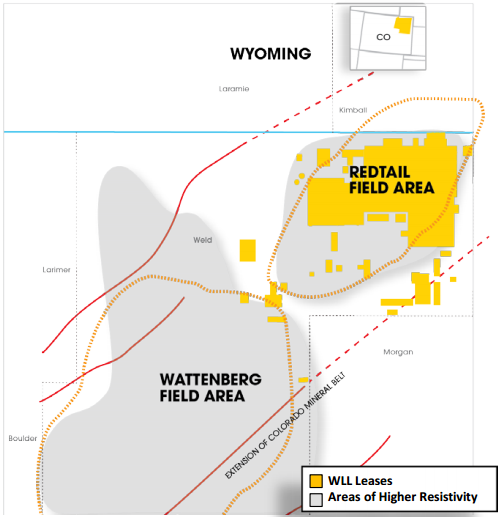
Redtail: 105 drilled uncompleted wells will be completed; second frac crew mobilized
Whiting has operations in the Redtail field of the DJ Basin, where it owns about 132,400 net acres. While the Redtail field only contributes 6% of current production, Whiting has plans to increase this share. The company intends to complete its entire DUC inventory in the field, 105 wells, this year. The company recently brought a second frac crew online to help accomplish this goal.
In total, Whiting spent $186 million in CapEx in Q1 to complete 48 gross wells. In 2017 the company plans to spend $1.1 billion, meaning that spending will be backloaded. James Volker, Whiting President and CEO, mentioned that 70 wells will be completed in the first half of 2017, while 163 will be completed in the second half.
Q&A from WLL Q1 2017 conference call
Do you need $55 oil?
Q: It seems that just speaking to some investors, they believe that much of your 2017 plan’s success relies on the $55 or higher oil. Could you address what you believe how the plan would fare in sort of a $45 to $55 range? I mean, by my judge, it looks like the economics are still quite good and the activity should be good. But I’d just like to hear your color on it.
James J. Volker: Our activity is designed to take us forward even at a $40 oil price environment. So, I would say we certainly wouldn’t consider cutting back until the trend got below $45. And I see everything that we’re doing in 2017, and for that matter, what we planned in 2018 already as being very economic even at $40 or $45 oil.
Q: So, you’d go forward – tackling the DUCs and everything, you would go forward with that?
James J. Volker: Absolutely. We have flexibility should something untoward happen, should oil prices, I’m going to say consistently go below 45 and maybe you can get below 40, something like that. We have plenty of flexibility to do that. We’re running, I’ll say, only six rigs, five in the Bakken, one at Redtail. We recently renewed three rigs at day rates that are almost $10,000-a-day lower than the prior rates. And we’re able to do that with extensions of the rig contracts of only 6 to 12 months.
So, we could drop all of those rigs for nominal fees. And in addition, we have two of our rigs that expire later this year, in November. And we have four completion crews running and we could drop all of them on a month’s notice. So, I would say we’re in a great flexible position and I would say the kind and quality of wells that we’re completing make good sense even in the mid-40s.
Q: And then, lastly, Jim for you or one of the other guys just on differentials obviously with DAPL and other things coming on seems that for you and others the base differential is really continuing to improve. Could you talk about how you foresee those remainder of the year and in 2018?
James J. Volker: It’s been a nice change for sure, coming down at least a couple bucks already. Some of our areas in the Bakken now are in the low 5s and the outlook is actually for that to even improve a little bit more. We haven’t put that into our guidance yet. But I would say that the outlook is for continuing shrinking differentials in the Bakken.
Q: Very impressive work on the Loomer pad. It looks like to me that three of those are Three Forks, first of all, is that right? And then secondly, of all these recent completions, because I know you guys have a bunch of them now. They’re tracking over 1 million. What’s kind of a general split on how many of those have been in the Bakken or Three Forks? If you could just help us understand if this is a phenomenon that’s extending to the Three Forks as well.
WLL Senior VP, Exploration & Development Mark R. Williams: So, our typical wine rack involves staggered Bakken/Three Forks development programs. So, we’re drilling roughly the same number of Three Forks wells as we are in the Bakken, plus or minus a few in different areas. In this case, it was two Three Forks wells and one Bakken well.
So, we have had good luck in our geo steering efforts in the Three Forks as we targeted the best part of the Three Forks that’s had an impact. And the larger completions that you mentioned especially on the Loomer pad, 8 million and above, have had – have been very effective on Three Forks as they have in the Bakken as well.