LNG demand exceeds domestic demand
While U.S. LNG continues to gradually establish itself as proposed export plants move through the planning and execution stage, Australia became the second-largest LNG exporter in the world.
Based on current projects, the country will become the world’s largest LNG exporter by 2019, surpassing Qatar. However, this expansion of its LNG export projects has not been without difficulties.
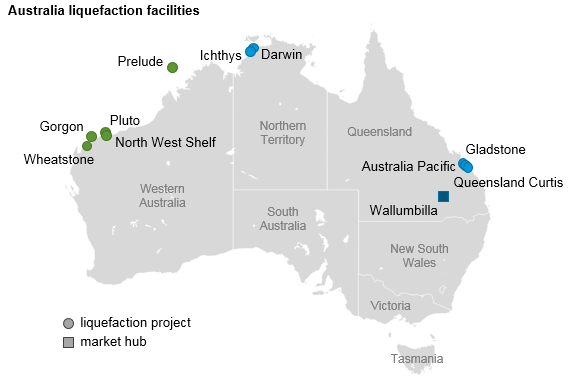
According to the EIA, domestic natural gas markets in Australia have seen recent price increases and supply shortages. Gas and electricity markets are separate in eastern and western Australia, as populations centers are separated by thousands of miles of desert. While both portions of the state have seen significant projects come online in recent years, Western Australia has been exporting LNG from the North West Shelf project for over 25 years.
Eastern Australia, by contrast, has only recently begun exporting gas from three major projects.
LNG demand is raising local prices
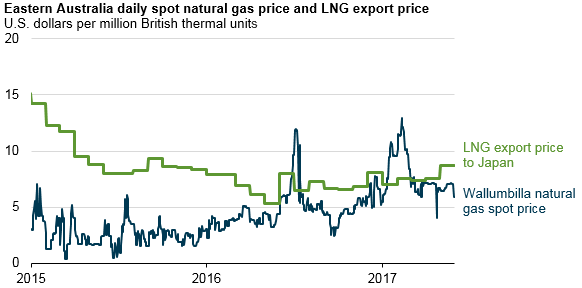
Since these projects began operations in late 2014, domestic natural gas prices in eastern Australia have risen significantly, and are currently more than double the pre-project levels. Supply shortages in mid-2016 and early 2017 caused gas prices to spike sharply, rising above $ 10/MMBTU. These prices exceeded LNG export prices to Japan, meaning LNG producers were receiving less for shipping gas than they would receive by putting it onto the local market.
Yesterday Reuters reported that Tellurian Inc. Vice Chairman Martin Houston said at a conference that Loading LNG at Tellurian’s proposed Driftwood plant is expected to cost $3 per million British thermal units (mmBtu) on a free-on-board (FOB) basis based on the combination of costs for the gas and the costs of cooling the fuel for transport at the terminal.
At that price, and including shipping LNG from the U.S. Gulf Coast to Japan, and the cost of financing the equity stake, buyers who purchase equity in the Driftwood plant could deliver gas to Japan at $6 per mmBtu, according to Houston.
Asian spot LNG prices LNG-AS for December were at $8.70 per mmBtu last week, Reuters reported.
LNG exports nearly double local consumption
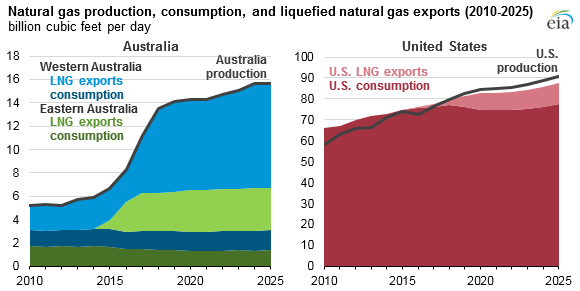
This sort of situation is not entirely surprising, as LNG export projects consumed almost twice as much gas as all of Eastern Australia in 2016, a proportion that will only continue to grow in the future. Australia’s Energy Market Operator, which manages the national electricity market for southeastern and eastern Australia and oversees electricity and natural gas retail markets and transmission, predicts that current contracts indicate there will be a shortfall of up to 270 MMcf/d in 2018 and nearly as large a shortfall in 2019. LNG producers have been forced to agree to limit LNG exports if the domestic market experiences similar price shocks.
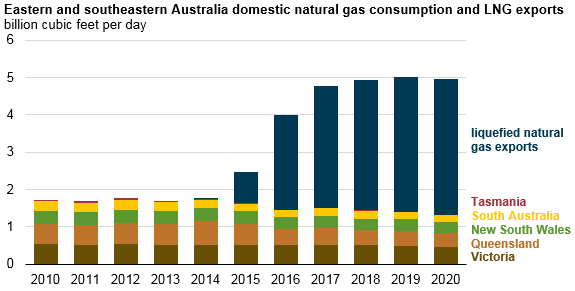
U.S. unlikely to see these problems—Australia will export 80% of its gas production, U.S. only 9%, by 2020
While these problems are concerning, it is unlikely the U.S. will experience the difficulties that Australia has seen. While the U.S. is likely to eventually export comparable volumes of LNG, it will have a much larger market to draw from. Australia’s LNG exports will consume 80% of domestic production by 2020, while U.S. LNG will account for only 9% of gas production in 2020.
In addition, the U.S. has much more extensive gas pipeline infrastructure, which decreases the likelihood of shortages of gas in local areas. The U.S. also has much more significant storage infrastructure, which would help prevent the sudden price spikes seen in Australia in the past year.